


 Our Own Special Issues
 |
This book was originally planned as the proceedings volume of the 1996 conference. However, the final book Scientific and Clinical Applications of Magnetic Microspheres is much more than the usual proceedings in that it is a current review of all the different applications of magnetic carriers. This highly useful
and educational book contains up-to-date, state of the art information of the entire field of magnetic carriers (see contents).
PLENUM Press, New York, 1997 The book is available at www.bestbookbuys.com. |
|
|
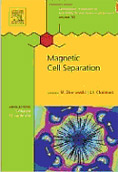 |
Magnetic Cell Separation This book wonderfully reviews the magnetic forces and field configurations to separate cells with magnetophoretic techniques. Particle synthesis specific for cell separation, cell toxicity testing and applications in biology are also described with many practical examples. Elsevier, Amsterdam, 2008 ISBN: 978-0-444-52754-7. 454 pp. Eds. Maciej Zborowski, Jeff Chalmers The book is available at www.amazon.com.
|
|
|
 |
Colloidal Magnetic Fluids: Basics, Development and Application of Ferrofluids Ferrofluids are fascinating and currently mainly used in technological applications. In order to better understand the basic physics and rheological behaviour, and extend their uses to biological applications such as magnetic drug targeting, the German Research Community has since 2000 sponsored a research program about the basic aspects of ferrofluids. This book is now the conclusion of these efforts by 90 scientists, precisely summarized in six chapters that include particle preparation and biomedical applications. The strongest parts, however, are the physical basis of (thermo)dynamics of ferrofluids, their spike formation, their rheological microscopic behaviour and finally a chapter of technical applications. It is truly a book about the state of the art of ferrofluids! Springer, Berlin, 2009 ISBN: 978-3540853862. 430 pp. Ed. Stefan Odenbach The book is available at www.amazon.com. |
|
|
 |
Magneto-Science This book describes the magnetic field effects on materials. If you ever wanted to know how to generate high magnetic fields, how magnetic levitation works, what magnetohydrodynamic or magnetothermodynamic effects are, then this book gives you all the fundamentals and applications. Dynamic spin chemistry is also described in detail. See contents. Kodansha/Springer, Tokyo, 2007 ISBN: 978-3540370611 Eds. Masuhiro Yamaguchi, Yoshifumi Tanimoto The book is available at www.amazon.com. |
|
|
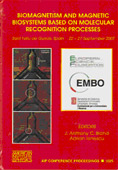 |
Biomagnetism and Magnetic Biosystems based on Molecular Recognition Processes This book was published after an interesting conference in Spain and tries to connect magnetic entities and materials with biomedical applications. Large advancements are also reported in the development of magnetic biosensors and detection systems. See contents. In memory of Tony Bland. American Institute of Physics, Melville, NY, 2008 AIP Conference Proceedings 1025 ISBN: 978-0-7354-0547-9 Eds. J. Anthony Bland, Adrian Ionescu The book is available through AIP. |
|
|
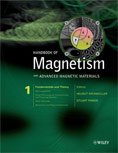 |
Handbook of Magnetism and Advanced Magnetic Materials, 5 Volume Set
This set of books about magnetism and magnetic materials is broken into 5 volumes focusing on Fundamentals and Theory, Micromagnetism, Novel Techniques for Characterizing and Preparing Samples, Novel Materials and Spintronics and Magnetoelectronics. (see contents). Wiley-VCH, Berlin, 2006 |
|
|
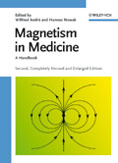 |
Another exciting book: Magnetism in medicine: A handbook 2nd Edition
This second, completely updated and extended edition of the only reference work in this growing field features new chapters on fetal magnetography and magnetic field therapy, as well as the safety aspects of magnetic fields. The main chapters are biomagnetism (biomagnetic instrumentation, cardiomagnetism, neuromagnetism and fetal magnetography), magnetic resonance (physical principles and technology of magnetic resonance imaging and modern applications of MRI) and magnetic substances and externally applied fields (magnetic monitoring as a diagnostic method, remote-controlled drug delivery, magnetic stimulation, liver iron susceptometry and more). (see contents and a review that was published in "Medical Physics"). Wiley-VCH, Berlin, 2006 |
|
|
 |
Colloidal Nanoparticles in Biotechnology
If you want to know the newest applications of colloidal nanoparticles in biotechnology, then this is the book for you. One chapter covers the use of magnetic nanoparticles as biosensors. (see contents). Wiley, 2008 |
|
|
 |
Nanotechnology in biology and medicine
This comprehensive book contains an excellent review article about magnetic nanoparticles as contrast agents for medical diagnosis (chapter 29) written by Louis Tiefenauer. Check it out! (see contents). CRC Press , 2007 |
|
|
 |
Nanoparticles and Occupational Health The first International Symposium on Nanotechnology and Occupational Health, in 2004, brought together hygienists, manufacturers, toxicologists, materials scientists, regulators and researchers. It pointed the way to what needs to be done. The second International Symposium, 2005, Minneapolis, Minnesota, demonstrated the power and potential where there is a will: with nearly three times as many attendants, and with contributions from academics, industry, policymakers, non-government organizations and even lawyers, this second symposium established that, while there is international concern over how to ensure safe nanotech-workplaces, there is also progress being made in developing the required knowledge. This volume, a reprint from a special issue of the Journal of Nanoparticle Research, mainly draws from work presented at the 2005 symposium, diverse but united by the need for a holistic view of nanotechnology and risk. Table of Contents Reprinted from JOURNAL OF NANOPARTICLE RESEARCH, 9:1, February 2007 |
|
|
 |
This book covers how teeth, bones, kidney stones
and other things are made by nature, in a process called Biomineralization.
What is interesting to the magnetic microsphere community is the fact that
almost half the book covers the biomineralization of magnetite - and there
are lots of useful things we can learn from Mother Nature! The second edition of this book was
just published in December 2004 and contains lots of new information,
especially about the use of bacteria to grow magnetic particles (see contents).
Wiley John and Sons (Wiley - VCH), New York, December 2004 |
|
|
 |
Anybody who is really interested in the most thorough researched History
of Magnetism should read this book - however, he will have to learn German for
this purpose!
VDE Verlag GmbH, Berlin, Offenbach, 1994 |
|
|
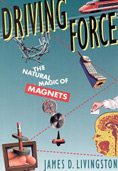 |
Driving Force - the natural magic of magnets
unfolds the long and colorful history of magnets: how they guided (or misguided) Columbus;
mesmerized eighteenth-century Paris but failed to fool Benjamin Franklin; lifted AC power
over its rival, DC and so on. In a way that will delight and instruct even the
nonmathematical among us, James Livingston shows us how scientists today are creating
magnets and superconductors that can levitate high-speed trains, produce images of our
internal organs, steer high-energy particles in giant accelerators, and heat our morning
coffee.
I have this book in my library and recommend it for everybody interested in magnets and magnetism - it is very entertaining and easy to read. Harvard University Press, Cambridge, Massachusetts, 1996 |
|
|
 |
Iron, Nature's Universal Element : Why
People Need Iron & Animals Make Magnets is an entertaining, challenging, but
also very informative book about the role iron plays and why it can't be replaced by any
other element.
Rutgers University
Press, New Brunswick, N.J., 2000 |
|
|
 |
Radiolabeled and Magnetic Particulates in Medicine
& Biology is part of the MML series that describes the preparation and
properties of all different kinds of microspheres, microcapsules, and liposomes. This
excellent series contains now already 8 volumes. Have a look at the content
here.
Citus Books, London, England, 2001 |
|
|
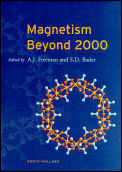 |
Magnetism beyond 2000 summarize the most significant recent and ongoing exciting scientific and
technological developments in 46 articles. It provide both the
flavor and meaning of magnetism as a vital field of importance to both basic science and
device applications.
Elsevier, 1999 |
|
|
 |
The Iron Oxides can be considered the standard text about the chemistry of iron and discusses in great detail the structure,
properties, reactions, occurrences and uses of iron oxides. There are color tables which
make it easy to determine what you synthesized in your lab - but even more important,
there are very exact methods given of making for example magnetite and not maghemite.
John Wiley & Sons Inc, 2003 |
|
|
 |
Magnetic Techniques for the Treatment of Materials
presents the changes during the last two decades in theoretical
understanding and practical implementation of magnetic techniques in
materials treatment. It covers magnetic separators based on permanent and
superconducting magnets, eddy-current separators and industrial
implementation of magnetic carriers and fluids.
Kluwer Academic Publishers, 2004 |
|
|
 |
Ferrofluids: Magnetically Controllable Fluids and Their Applications is an excellent review about the basic theories and applications of magnetic fluids. Have a look at the table of contents here.
Springer Verlag, 2002 A detailed treatise of the Magnetoviscous Effects in Ferrofluids is discussed in a separate book. Springer Verlag, 2002 |
|
|
 |
Although more about the synthesis of polymeric colloids and biomolecules, two books published in honor of the retirement of Prof.
Christian Pichot contain some information about magnetic particles. The first book is Colloidal Polymers:
Marcel Dekker, 2003 And the second book in the same series is Colloidal Biomolecules, Biomaterials, and Biomedical Applications: Marcel Dekker, 2003 |