

Magnetic Carrier Meeting 2018 in Copenhagen
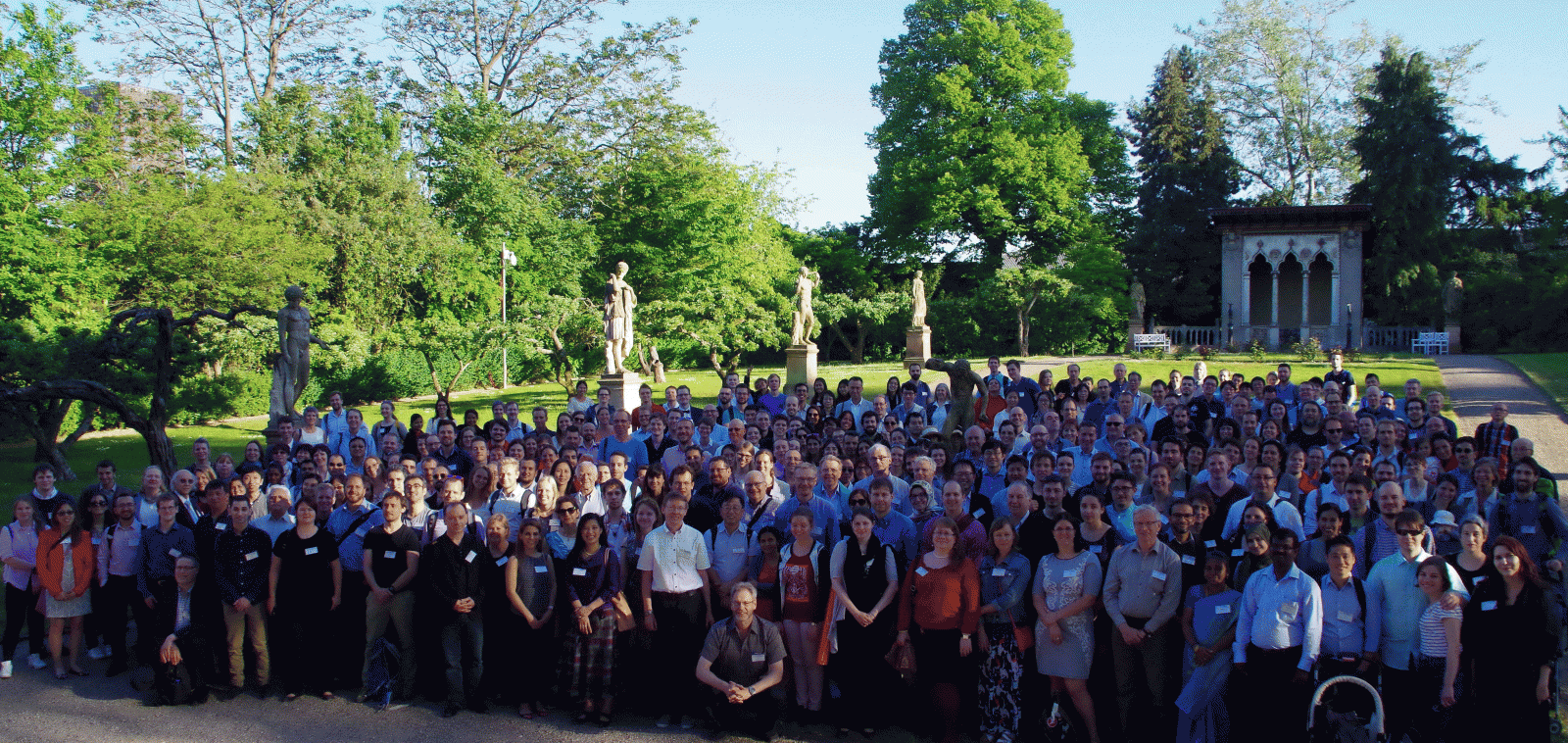
May 22, 2018Our 12th International Conference on the Scientific and Clinical Applications of Magnetic Carriers took place at the University of Copenhagen's new Maersk building.from May 22-26, 2018. Most of the 328 participants are visible from the picture below - click on it to get a higher resolution version.
If you want to check out the program, the entire abstract booklet is available online.
Weird Magnetic Effect Could Improve Computer Memory
April 28, 2018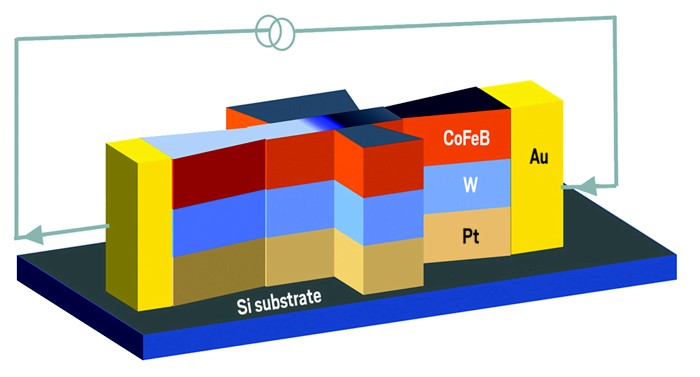 For decades, applied physicists and semiconductor companies have developed computer memory that uses the direction of a magnetic field to store data. A magnetic pulse or a jolt of electricity can change the properties of an island of magnetic material, flipping its field up or down to represent a 1 or a 0. The primary advantage of this so-called magnetoresistive random access memory (MRAM) is its durability. Johns Hopkins University physicist Chia-Ling Chien developed memory that can be written using smaller pulses of current. This would reduce power requirements and improve the lifetime of the memory arrays. Chien worked with an experimental device made up of nanometer-thin layers of a cobalt-iron-boron ferromagnet, a metal oxide, and tungsten held between a pair of gold electrodes. The researchers could flip the polarization of the CoFeB magnet by applying current through the electrodes, but only in the presence of a magnetic field. The tungsten layer acts as a kind of electron filter, allowing in only electrons with a particular spin. The momentum of that spin gets transferred to the magnet and flips the field.
While studying this device, Chien’s team found something weird. They wanted to see what happened when they broke one of the memory devices. They added a layer of platinum under the tungsten, expecting it would cancel out the spin-switching effect. “Anyone who understands spin-orbit torque will realize this is a stupid thing to do, because tungsten and platinum have opposite spin currents.” But the device didn’t stop working. Instead, the team found they could switch the platinum-frosted device simply by applying an electrical current—no magnetic field required. This simplification means such devices should be less complicated to build and operate. For more info, see here.
Magnetic Particle Imaging (MPI) Guided Magnetic Hyperthermia Therapy
March 27, 2018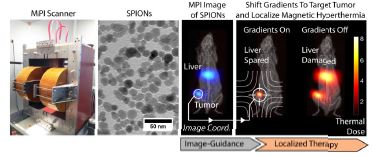 Zhi Wei Tay et al. describe in the newest ACS Nano article how the labs of Steven Connolly and Carlos Rinaldi combined MPI and Magnetic Hyperthermia and tested successfully a theranostic platform for future cancer therapy. They showed experimental data using MPI gradients to deliver targeted heating on demand to components of a phantom with an ability to selectively heat targets separated by as little as 7 mm with negligible heating of off-target sites. Results from a rodent model are very promising.
MPI seems to be an excellent tool for thermal dose planning via an MPI pre-scan. Through a luciferase assay and histological assessment, they verified that heat damage was indeed localized to the target tumor. They further describe that an important next step is to develop MPI thermometry for in vivo implementation in order to provide a temperature feedback mechanism for complete thermal dose control.
Because achieving macroscopic heating with low amplitudes remains a challenge, another important direction is to explore MPI-magnetic hyperthermia for applications in targeted drug release by using the MPI gradient localization strategy to localize actuation of the drug-containing nanocarriers. Exploring other therapeutic approaches that do not require macroscopic temperature changes, such as activation of lysosomal pathways and thermal drug delivery, are also of great interest.
To read more, check out this link.
New Toyota Magnet Cuts Rare-Earth Use
March 26, 2018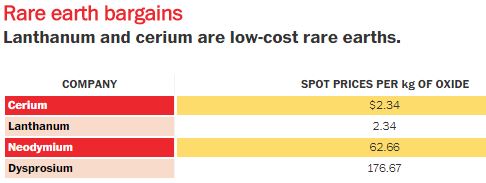 The rise of electric vehicles is threatening supplies of a host of the earth’s elements. Cobalt and lithium for batteries are getting most of the attention, but rare earths for electric motors are also a pinch point. Now, Toyota Motor scientists have developed a new recipe for the motors’ permanent magnets that cuts reliance on particularly rare rare earths.
Permanent magnets keep electric motors turning in all kinds of devices, from electric toothbrushes to refrigerator compressors. In electric vehicles, the magnets need to last a long time without demagnetizing. They also have to stay stable at temperatures that can reach 100 ºC. To meet those requirements, the magnets are made up of 30% rare earths, to take advantage of their many unpaired electrons, and 70% iron. The go-to rare earth for powerful, durable magnets is neodymium.
Most of this pricey element comes from China, and Toyota says demand is expected to increase rapidly. Smaller amounts of terbium or dysprosium are added to neodymium to lend heat resistance, but those elements are even more expensive. Toyota has already cut terbium and dysprosium use in the 2016 Prius, and future magnets won’t use any, the firm promises. In addition, up to 50% of the neodymium will be replaced with the low-cost rare earths lanthanum and cerium.
To make the new recipe work, Toyota scientists reduced the size of the magnet’s grains to 0.25 micrometers, one-tenth their original size. They then concentrated neodymium on the surfaces of the smaller grains; the grains in standard magnets have the expensive element throughout. Looking inside the grains, they found that a 1:3 ratio of lanthanum to cerium is needed to prevent magnet performance from deteriorating.
Toyota says the new magnets could reach the market in the first half of the 2020s. They could also be used in robots and household appliances.
Iron Salts Produce Beautiful Crystal Landscape
March 26, 2018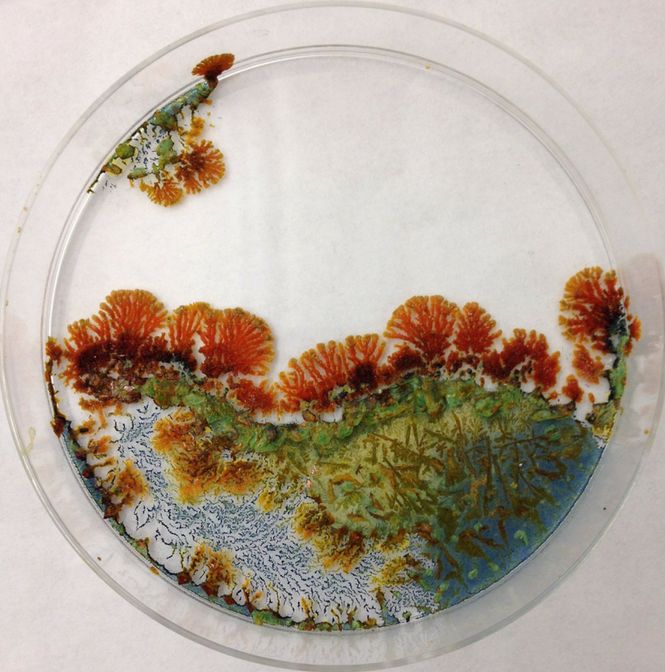 Alexis Ostrowski's lab at Bowling Green State University studies reactions of iron salts, where iron (III) is reduced by light. Sometimes, the results are spectacular, like in this petri dish, where Fe(III) ammonium citrate (green) and potassium ferricyanide (orange and yellow) turn into blue Fe(II) salts, like Prussian Blue etc.
Using Nature's Motors to Deliver Drugs
March 20, 2018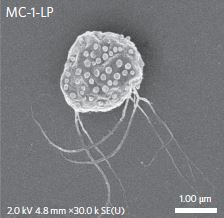 In a recent C&EN article, it was mentioned that bacteria and sperm have natural advantages over synthetic nanomotors when navigating the body’s byways. And as an example for how to exploit that they gave the example of how Sylvain Martel at the Polytechnique Montreal used a strain of Magnetococcus marinus bacteria called MC-1 to carry anticancer drugs into tumors within mice (Nat. Nanotechnol. 2016, DOI: 10.1038/nnano.2016.137). This bacteria species is a good choice for entering tumors, he says, because it likes a low-oxygen environment, which is typically found in tumors.
Martel’s team created the swimmers by covering individual MC-1 bacterial cells with over 70 nanosized liposomes containing anticancer drugs. This keeps the overall size of the swimmers under 2 µm, small enough to enter and move around within tumors, Martel says. The researchers tested the swimmers in mice that had colorectal tumors by injecting the swimmers a few millimeters outside the tumors, magnetically guiding the swimmers into the tumors, and then letting them penetrate deep inside. Up to 55% of the injected swimmers entered the tumors, concentrating around regions with particularly low oxygen levels.
Combination of MPI and MFH
December 08, 2017
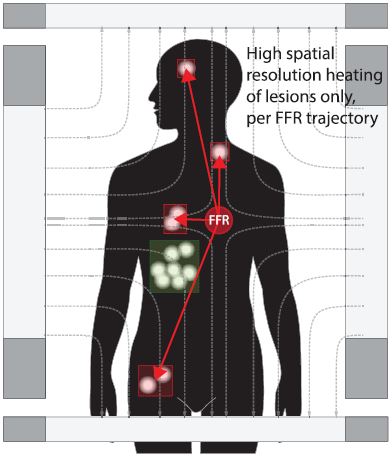 Steve Conolly and his group together with Carlos Rinaldi and his group have just published an interesting article about combining magnetic fluid hyperthermia (MFH) and magnetic particle imaging (MPI). The physics germane to and exploited by MPI and MFH are similar, and the same magnetic particles can be used effectively for both. Consequently, the method of signal localization through the use of gradient fields in MPI can also be used to spatially localize MFH, allowing for spatially selective heating deep in the body and generally providing greater control and flexibility in MFH. Furthermore, MPI and MFH may be integrated together in a single device for simultaneous MPI-MFH and seamless switching between imaging and therapeutic modes.
The authors show simulation and experimental work quantifying the extent of spatial localization of MFH using MPI systems. They report the first combined MPI-MFH system and demonstrate on-demand selective heating of nanoparticle samples separated by only 3 mm (up to 0.4 °C per second heating rates and 150 W/g SAR deposition). They also show experimental data for MPI performed at a typical MFH frequency and show preliminary simultaneous MPI-MFH experimental data.
Check the paper out here.
Iron-Oxide Nanoparticle-Based Magnetic Resonance Contrast Agents
December 02, 2017
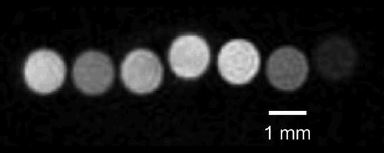 If you ever needed to know all about magnetic nanoparticles as MRI contrast agents, then you have it now all in one place. A large group of authors just published a comprehensive review of this field as chapter 4 of of the book "New Developments in NMR No. 13, Contrast Agents for MRI: Experimental Methods", Edited by Valerie C. Pierre and Matthew J. Allen, The Royal Society of Chemistry 2018.
If you can't find it in your library, then please contact Ladislau Vekas, he can help you out.
For more information, check out our Archives.
September 2017
Search this site with the power of